Why At-Home Teeth Whitening Kits Are Replacing Dentist Visits in 2026
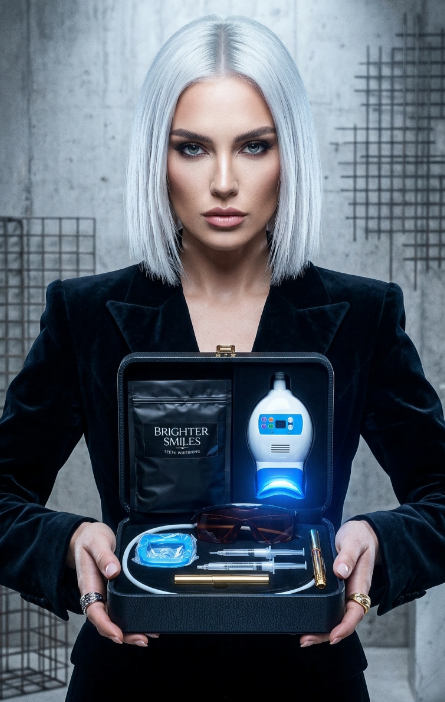
Brighter Smiles Teeth Whitening Kit
There was a time when getting a noticeably whiter smile meant booking an appointment, sitting in a dental chair for over an hour, and handing over anywhere from $300 to $1,000 for professional bleaching. In 2026, that is no longer the only option — and for millions of adults, it is no longer the preferred one. The best at-home teeth whitening kits have quietly transformed from a compromise into a genuine alternative, delivering results that match professional treatments at a fraction of the cost and without leaving your bathroom. This article explores why the shift is happening, what is actually driving it, and how to find the best way to whiten teeth at homewithout sacrificing safety or results.
The Rise of At-Home Teeth Whitening
The global teeth whitening market has grown rapidly over the past decade, and the fastest-growing segment is not professional dental treatments — it is consumer products. According to industry analysts, the at-home whitening category now accounts for more than 60% of all teeth whitening purchases in the United States. What was once considered a watered-down version of the real thing has evolved into a legitimate, science-backed approach to achieving a brighter smile.
Several forces are driving this shift. First, consumers are more ingredient-aware than ever before. They read labels, research formulations, and demand to know what they are putting in their bodies. Second, the convenience economy has conditioned people to expect professional-quality results at home — from skincare to fitness to cosmetic dental care. Third, and perhaps most importantly, the formulas themselves have gotten dramatically better.
The bestat-home teeth whitening kits available today are not the flimsy strips your parents tried in the early 2000s. Modern kits use professional-grade whitening agents, sensitivity-protective formulas, and delivery systems that maximize contact time between the whitening agent and the tooth surface. The gap between what dentists offer and what you can do at home has narrowed considerably — and for many buyers, it has closed entirely.
"The gap between professional dental whitening and the best at-home teeth whitening kits has never been smaller."
Why Dentist Visits Are Losing Ground
To understand why more people are choosing to whiten teeth at home, it helps to understand what has frustrated them about the alternative. Professional in-office whitening is effective — nobody disputes that. But it comes with a set of drawbacks that many adults are no longer willing to accept:
The Case Against In-Office Whitening
Cost: In-office bleaching typically runs $300–$1,000 per session, and results are not permanent — many patients return every 6–12 months
Sensitivity: High-concentration professional bleaching is a common cause of post-treatment tooth and gum sensitivity, sometimes lasting several days
Convenience: Appointments take 60–90 minutes, require advance scheduling, and are often not covered by dental insurance
Results don't last: Without a maintenance routine, professional whitening fades within months — especially for coffee, tea, and red wine drinkers
Access: Not everyone has easy access to a cosmetic dentist, and many people are simply not comfortable in a dental chair
When you weigh these factors against a high-quality at-home teeth whitening kit that costs a fraction of the price, delivers visible results in 7–14 days, and can be used on your own schedule, the value proposition becomes clear. For a growing segment of the market — particularly Millennials and Gen X adults — the dentist visit is no longer the default.
How to Whiten Teeth at Home: What Actually Works
With so many products on the market claiming to be the best teeth whitening at home solution, it can be hard to know where to start. Not all whitening products are created equal, and the difference between a product that works and one that disappoints often comes down to a few key factors: the concentration of the active whitening agent, the quality of the supporting ingredients, and the delivery system.
Understanding the Active Ingredient
The most effective whitening agents are peroxide-based compounds — specifically hydrogen peroxide and carbamide peroxide. These agents work by penetrating the enamel and breaking down the chromogen molecules (the compounds responsible for staining) through an oxidation process. The higher the concentration, the faster and more dramatic the whitening effect — but also the higher the risk of sensitivity if the formula is not properly balanced.
Drugstore whitening strips typically contain low concentrations of hydrogen peroxide — often 6–10%. Professional in-office treatments use concentrations of 25–40%. Premium at-home teeth whiteningkits, like Brighter Smiles, sit in the middle ground — using professional-grade concentrations that deliver meaningful results while incorporating sensitivity-protective agents that make extended use safe and comfortable.
The Delivery System Matters
How the whitening agent gets to your teeth is just as important as what's in it. The three most common delivery systems in consumer whitening products are strips, trays, and pens. Each has trade-offs:
Strips: Convenient but inconsistent — strips often miss the edges of teeth and can slide during wear, reducing contact time with the tooth surface. Most over-the-counter strips also use lower concentrations to compensate for these limitations.
Trays: More effective because they mold to the shape of your teeth and hold the whitening agent against the entire surface. Custom-fitted trays (either from your dentist or from a premium at-home kit) deliver the most even, consistent results.
Pens: Best used as a touch-up tool between treatments rather than a primary whitening method. They are portable and convenient but not powerful enough for significant whitening on their own.
The best way to whiten teeth at homeis to use a kit that combines a high-quality whitening agent with a delivery system that maximizes contact time — and pairs that with ingredients designed to protect your enamel and minimize sensitivity throughout the process.
Here is what the research and clinical experience consistently shows about how to whiten teeth at home fast:
Follow the recommended wear time: More is not better. Leaving a whitening agent on longer than recommended can cause sensitivity and damage enamel without meaningfully accelerating whitening. Follow the instructions.
Start with clean teeth: Brush your teeth immediately before applying any whitening treatment. Clean teeth allow the whitening agent to work directly on the enamel rather than on surface plaque.
Avoid staining foods and drinks during treatment: Coffee, tea, red wine, and deeply pigmented foods counteract the whitening process during active treatment. Try to avoid them for the 14-day treatment window, or consume them with a straw.
Use a sensitivity toothpaste: If sensitivity is a concern, use a potassium nitrate toothpaste (like Sensodyne) in the days leading up to and during your whitening treatment. This pre-treats the nerve channels and significantly reduces discomfort.
What to Look for in the Best At-Home Teeth Whitening Kit
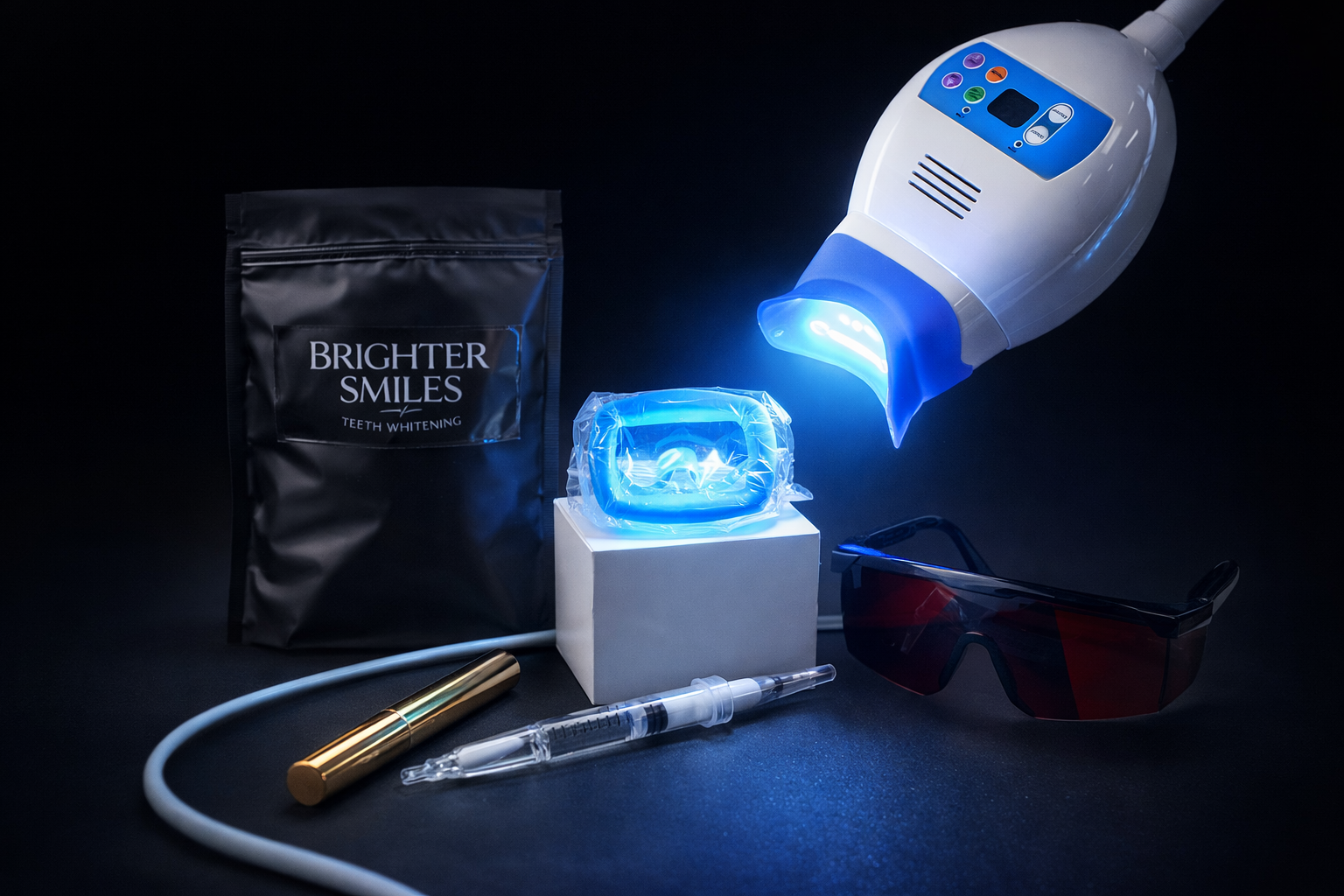
Not every product that calls itself the best at home teeth whitening kit deserves the title.
Here are the specific markers of a premium product — the ones that separate a genuine performer from a gimmick:
1. Transparent Ingredient List
A trustworthy whitening kit will tell you exactly what is in it and at what concentration. If a product lists only proprietary blends without disclosing active ingredient concentrations, that is a red flag. The best teeth whitening at home products are transparent about their formulation because their formula is a feature, not a secret.
2. Sensitivity Protection
Sensitivity is the number one reason people abandon whitening treatments. The best kits include desensitizing agents — typically potassium nitrate or sodium fluoride — that protect the nerve endings while the whitening process takes place. This is not an afterthought feature; it is a core requirement for safe, repeatable use.
3. Professional-Grade Concentration Without Overreach
There is a sweet spot in whitening agent concentration — strong enough to penetrate staining compounds efficiently, but calibrated to avoid enamel damage. Premium at-home teeth whitening kits are formulated to sit in this range. Products that advertise extremely high concentrations without sensitivity protection are not safer or more effective — they are poorly formulated.
4. Verified Real-World Results
Before and after photos, independent reviews, and social proof from real customers are the best evidence of a product's effectiveness. The best way to whiten teeth at home is always the method that has been verified by people with teeth and lifestyles similar to yours — not just marketing photography.
5. A Luxury Experience That Matches the Price
If you are investing in a premium at-home teeth whitening kit, the experience should reflect that. The packaging should feel premium, the instructions should be clear, and the formula should feel comfortable to use. A product that costs $100 but feels like a $15 drugstore kit has a quality misalignment that often extends to the formula itself.
How to Whiten Your Teeth at Home: A Step-by-Step Guide
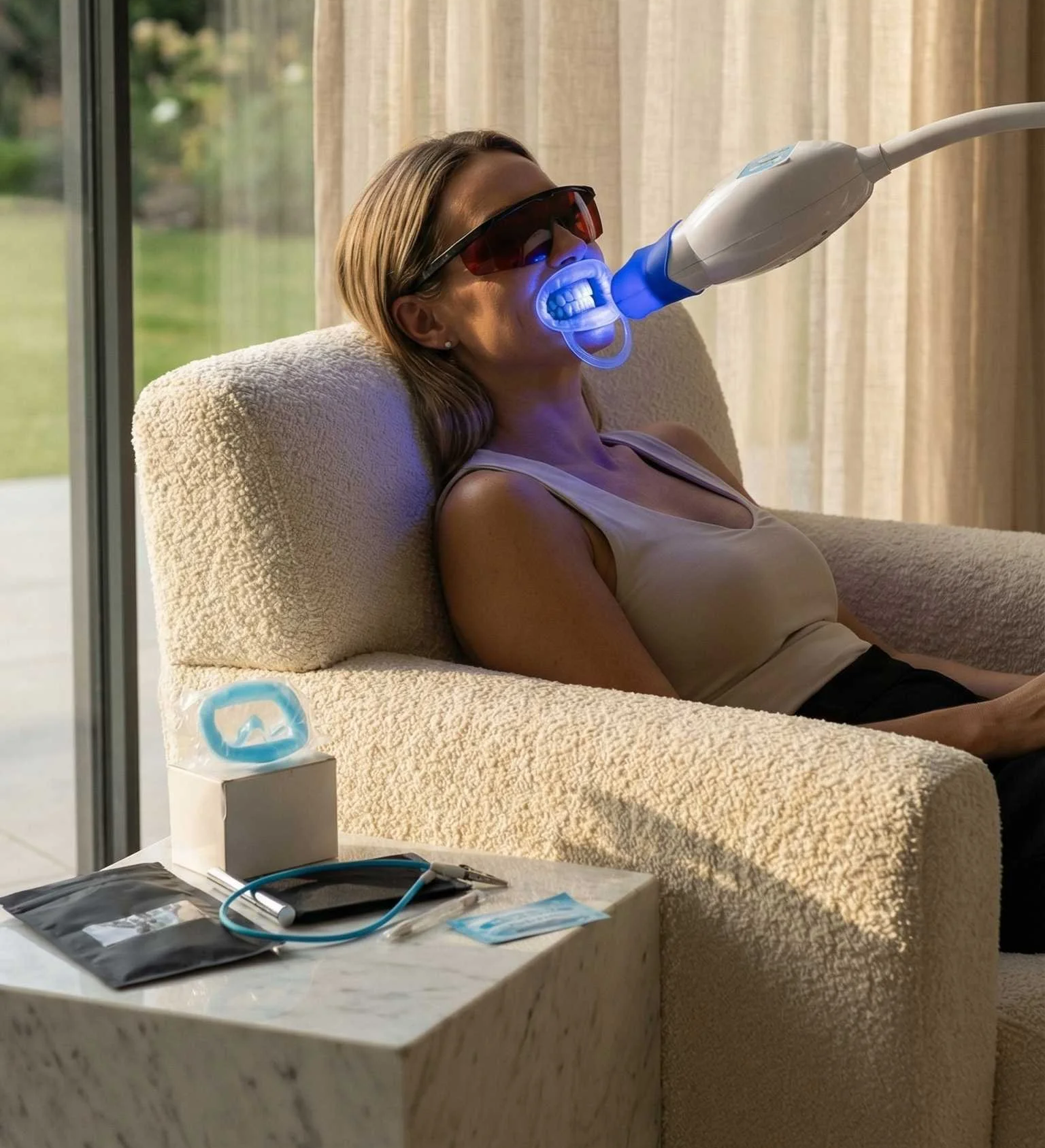
Regardless of which kit you choose, the fundamental process for how to whiten your teeth at home is the same.
Here is the step-by-step approach that delivers the best results:
Brush and floss first. Never apply a whitening product to unclean teeth. Plaque and food residue create a barrier between the whitening agent and your enamel.
Apply the whitening agent as directed. If using a tray system, fill the tray to the recommended line — do not overfill. Excess gel that contacts your gums can cause irritation.
Wear for the recommended time. Set a timer. Do not exceed the recommended wear time, especially in the first few days. Your teeth will tell you if the product is too strong — sensitivity during wear is a signal to reduce the time slightly.
Rinse thoroughly. After removing the tray or strips, rinse your mouth with water to remove any remaining whitening agent from your gums and soft tissue.
Avoid staining foods for 30–60 minutes. Your enamel pores are temporarily more open immediately after whitening, making your teeth slightly more susceptible to staining. Avoid coffee, tea, and colored foods for at least 30 minutes post-treatment.
The Sensitivity Question: Is At-Home Whitening Safe?
The most common concern about whitening teeth at home is sensitivity — and it is a legitimate one. Peroxide-based whitening agents work by temporarily opening the microscopic tubules in your enamel, which can expose the nerve endings beneath. This is what causes the zingy sensitivity that some people experience during or after whitening.
The good news is that sensitivity from at-home whitening is almost always temporary and manageable. For the vast majority of users, it resolves within 24–48 hours of completing a treatment. The key is choosing a product with built-in sensitivity protection and following usage guidelines rather than pushing for faster results by extending wear time or using the product more frequently than recommended.
People who are most prone to sensitivity include those with naturally thin enamel, existing dental work and those who have recently had dental cleaning or fillings. If you fall into any of these categories, start with shorter wear sessions and build up gradually — or consult your dentist before beginning any whitening regimen.
Who Should Use Caution with At-Home Whitening
People with extremely sensitive teeth — start with shorter wear times and choose a kit with desensitizing agents
People with gum disease or untreated cavities — address these with your dentist before whitening
Pregnant or breastfeeding women — consult a healthcare provider before use
Children under 14 — enamel is still developing; at-home whitening is not recommended for minors
Brighter Smiles: The Best At-Home Teeth Whitening Kit for Real Results
At Brighter Smiles, we built our kit specifically for adults who have been let down by drugstore whitening strips and are tired of paying professional prices for results that fade within months. Our formula combines a professional-grade whitening agent with a sensitivity-protective blend — so you get visible results in as little as 7 days without the discomfort that typically comes with stronger concentrations.
We believe that the best at home teeth whitening experience is one that respects your intelligence as a consumer. That means being completely transparent about what is in our formula, using clean ingredients you can actually pronounce, and designing a kit that feels as premium as it performs.
The result of 14 days of consistent use with Brighter Smiles is not just a brighter smile. It is the version of yourself that smiles freely — in photos, in meetings, on first dates, in any room you walk into. That is what we set out to give you. And that is what the best teeth whitening at home should deliver.
"Your brightest self is already in there. We just help you show it."
Frequently Asked Questions
How long does at-home teeth whitening take to work?
Most people see noticeable results within 7 days of daily use with a professional-grade at-home teeth whitening kit. Full results — typically 3–8 shades lighter depending on your baseline — are achieved after a complete 14-day treatment cycle.
What is the fastest way to whiten teeth at home?
The fastest way to whiten teeth at home is to use a high-quality kit with a professional-grade whitening agent. Consistency is the single biggest driver of speed. Skipping days or using the product intermittently significantly extends the timeline.
Is it safe to whiten teeth at home?
Yes — when using a properly formulated kit as directed. Premium at-home teeth whitening kits designed for daily use include desensitizing agents that make consistent use safe. Avoid exceeding the recommended wear time, and take a break if you experience persistent sensitivity.
How do I whiten my teeth at home without sensitivity?
To minimize sensitivity when whitening teeth at home, choose a kit that includes a desensitizing agent like potassium nitrate, use a sensitivity toothpaste in the days before and during treatment, and never exceed the recommended wear time.
Can at-home whitening match dentist results?
For most people, yes — with the right product. The best at-home teeth whitening kits use formulas that are close in strength to what dentists use for take-home treatments.
Ready to Meet Your Brightest Self?
If you have been waiting for the right moment to try teeth whitening at home— this is it. The technology is better than it has ever been. The formulas are cleaner. The results are real. And with the right kit, you do not have to choose between professional-grade whitening and a product that is safe for daily use.
Brighter Smiles was built for adults who are done settling for results that disappoint. Whether you are looking for the best way to whiten teeth at home before a big event, trying to maintain a professional-looking smile without recurring dentist bills, or simply ready to feel more confident every time you smile — our kit was designed with you in mind.
Shop the Brighter Smiles At-Home Whitening Kit today and start your journey to your brightest self.